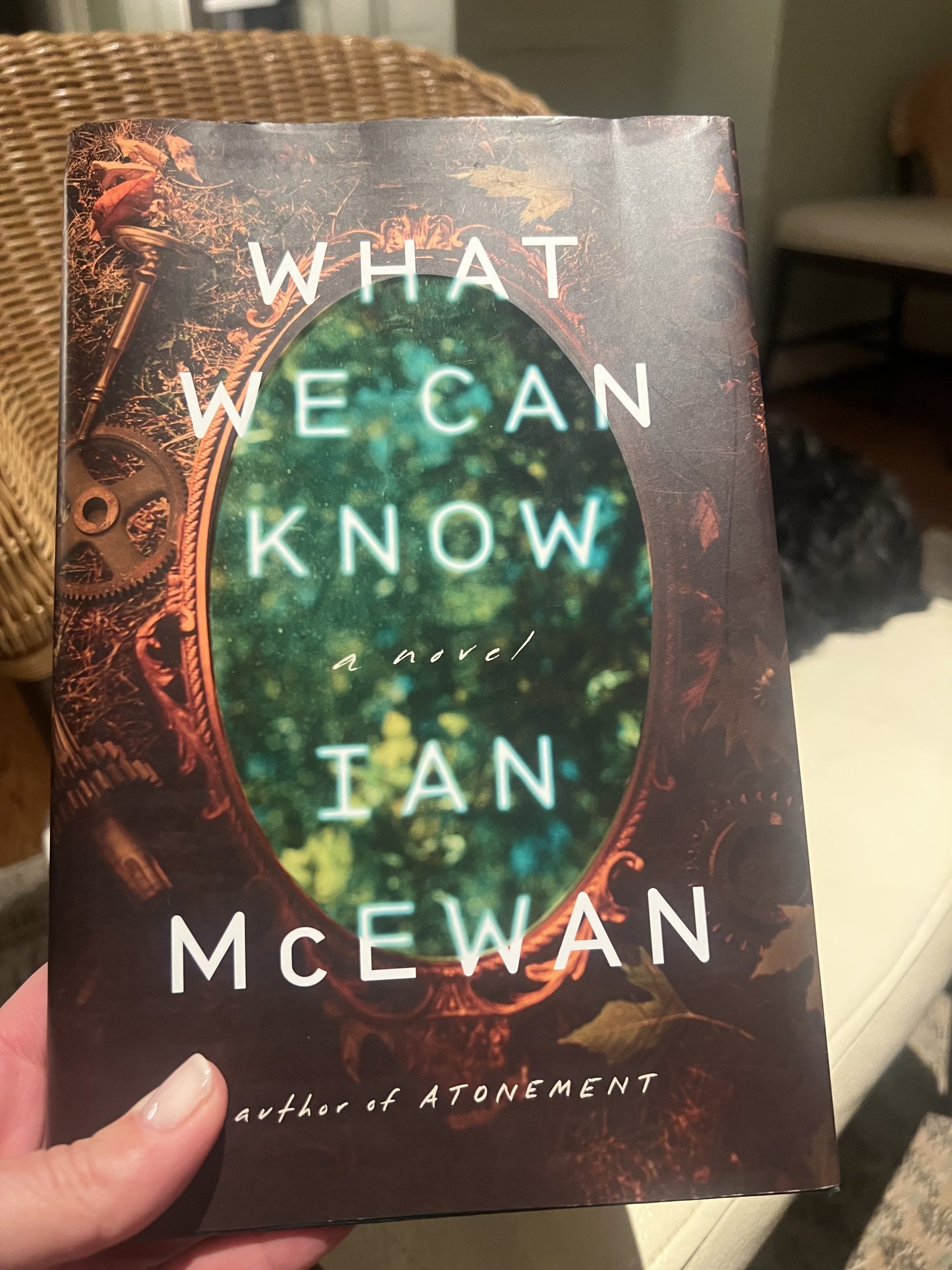
We don’t really know anyone else’s heart or mind. Or what they might be capable of. We know this – right? – if we’ve lived long enough. Ian McEwan’s new novel What We Can Know conveys this truth. The joy is in the tale well told.
The plot, in short, is this (no spoilers): a historian in the future sets out to find a long-lost poem, one that has achieved the status of legend and myth in its absence. The book is set between the future, ravaged by climate disaster and war, and the present, the cozy English countryside. The lost poem was written by one of the literary greats of the late 20th century in honor of his also literary wife. Their marriage is far more complicated than it appears – the tie that binds far deeper and stranger. This book would make a good gift for someone who likes ambitious literary fiction and is willing to slog through a slow beginning. The payoff? Shock and awe. He’s done it again, Ian McEwan – laid out for us the human condition in its horror and glory.
***
Last week, at the local bookstore, a neon orange cover caught my eye.
I noticed that there was only one of these books left in a place where there had been quite a few more (it appeared).
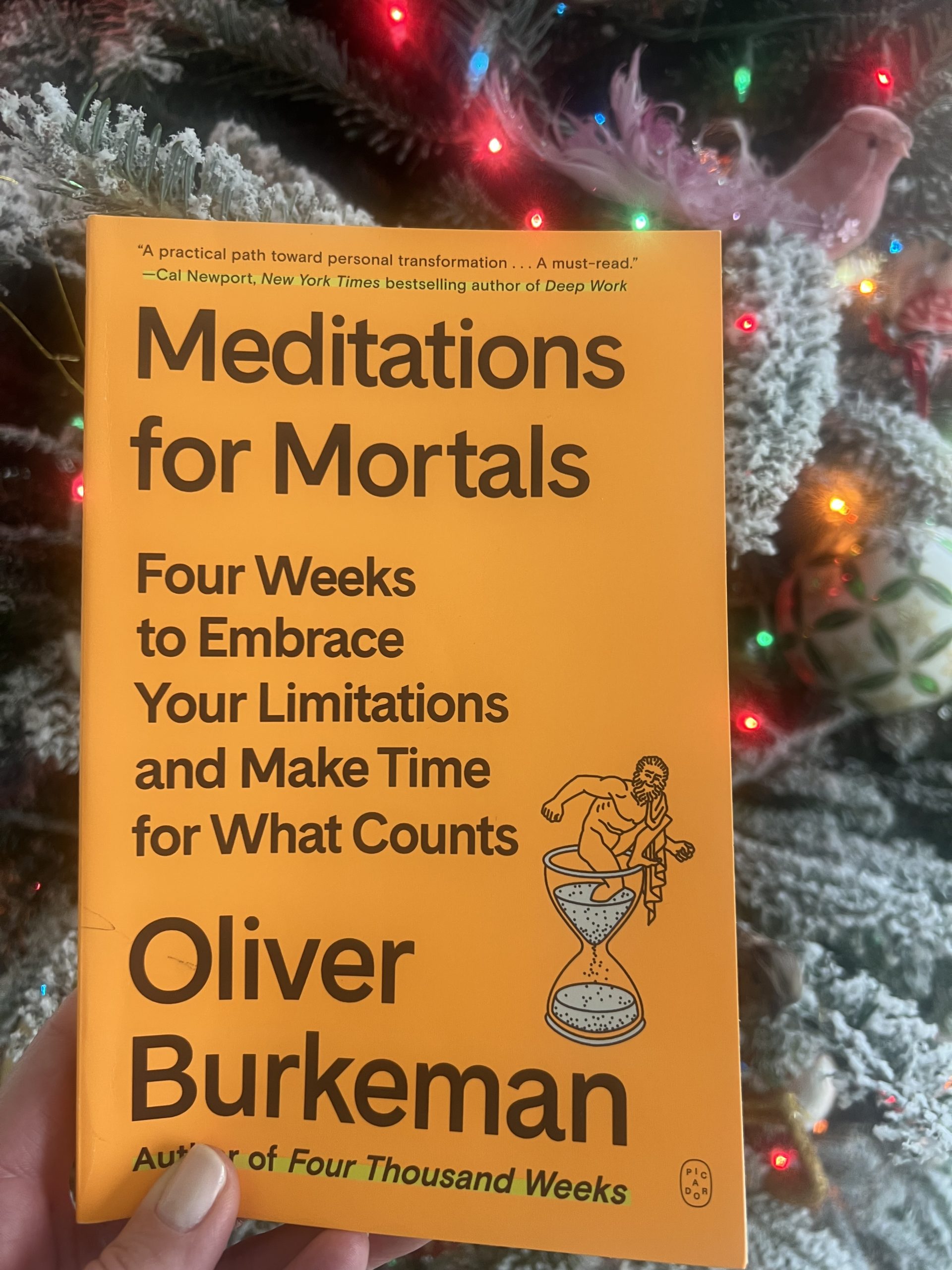
I’m following the recommended course of action – one short chapter a day – and I’ve loved reading Meditations for Mortals: Four Weeks to Embrace your Limitations and Make Time for What Counts.
I’ll share some of it with you over the next few weeks!
From the first chapter:
DAY ONE
It’s worse than you think
On the liberation of defeat
…The late British Zen master Houn Jiyu-Kennett, born Peggy Kennett, had a vivid way of capturing the sense of inner release that can come from grasping just how intractable our human limitations really are. Her teaching style, she liked to say, was not to lighten the burden of the student, but to make it so heavy that he or she would put it down. Metaphorically speaking, lightening someone’s burden means encouraging them to believe that, with sufficient effort, their struggles might be overcome: that they might indeed find a way to feel like they’re doing enough, or that they’re competent enough, or that relationships are a piece of cake, and so on. Kennett’s insight was that it can often be kinder and more effective to make their burden heavier. To help them see how totally irredeemable their situation is, thereby giving them permission to stop struggling.
And then? Then you get to relax. But you also get to accomplish more, and to enjoy yourself more in the process, because you’re not longer so busy denying the reality of your predicament, consciously or otherwise. This is the point at which you enter the sacred state the writer Sasha Chaplin refers to as ‘playing in the ruins.’
In his twenties, Chaplin recalls, his definition of a successful life was that he should become a celebrated novelist, on a par with David Foster Wallace. When that didn’t happen – when his perfectionist fantasies ran up against his real-world limitations – he found it unexpectedly liberating. The failure he’d told himself he couldn’t possibly allow to occur had, in fact, occurred, and it hadn’t destroyed him. Now he was free to be the writer he actually could be. When this sort of confrontation with limitation takes place, Chaplin writes, ‘a precious state of being can dawn… You’re not seeing the landscape around you as something that needs to transform. You’re just seeing it as the scrapyard it is. And then you can look around yourself and say, okay, what is actually here, when I’m not telling myself constant lies about what it’s going to be one day?” With this comes the bracing understanding that you might as well get on with life: that it’s precisely because you’ll never produce perfect work that you might might as well get on with doing the best work you can; and that it’s because intimate relationships are too complex ever to be negotiated entirely smoothly that you might as well commit to one, and see what happens. There are no guarantees – except the guarantee that holding back from life instead is a recipe for anguish.
Because our problem, it turns out, was never that we hadn’t yet found the right way to achieve control over life, or safety from life. Our real problem was imagining that any of that might be possible in the first place for finite humans…
I looked up Ian McEwan on Wikipedia just now to learn that he is 77 years old. I love that after all the years he has been writing he can still write something like What We Can Know that is so rich and challenging and altering.
And in this season of Advent I was thinking that so much of what you wrote about the message from the Meditations book is the message of Christianity. The message is not – Try Harder! The message is: It Is Finished.
Beautifully said, Mary. As always. I am so blessed by your friendship. Xoxo
Thank you again, Jennifer, for another lovely and rich post to begin my day.
I have read several of McEwan’s books and enjoy his writing. I appreciate your comments on his newest book. Thanks also for sharing some content in “Meditations for Mortals …” — you definitely have me interested in the shared wisdom and perspectives in that book.
As always, your nature photos invite peace and calmness into my mind.
Wishing you and others who read your posts — blessings and love during this season.
Blessings and love to you as well, Paulette! Thank you for staying in touch! Xoxo