
I’m starting the new year with this question in mind. Oliver Burkeman, in Meditations for Mortals, suggests it as an approach to just about everything. Hear him out! It’s genius.
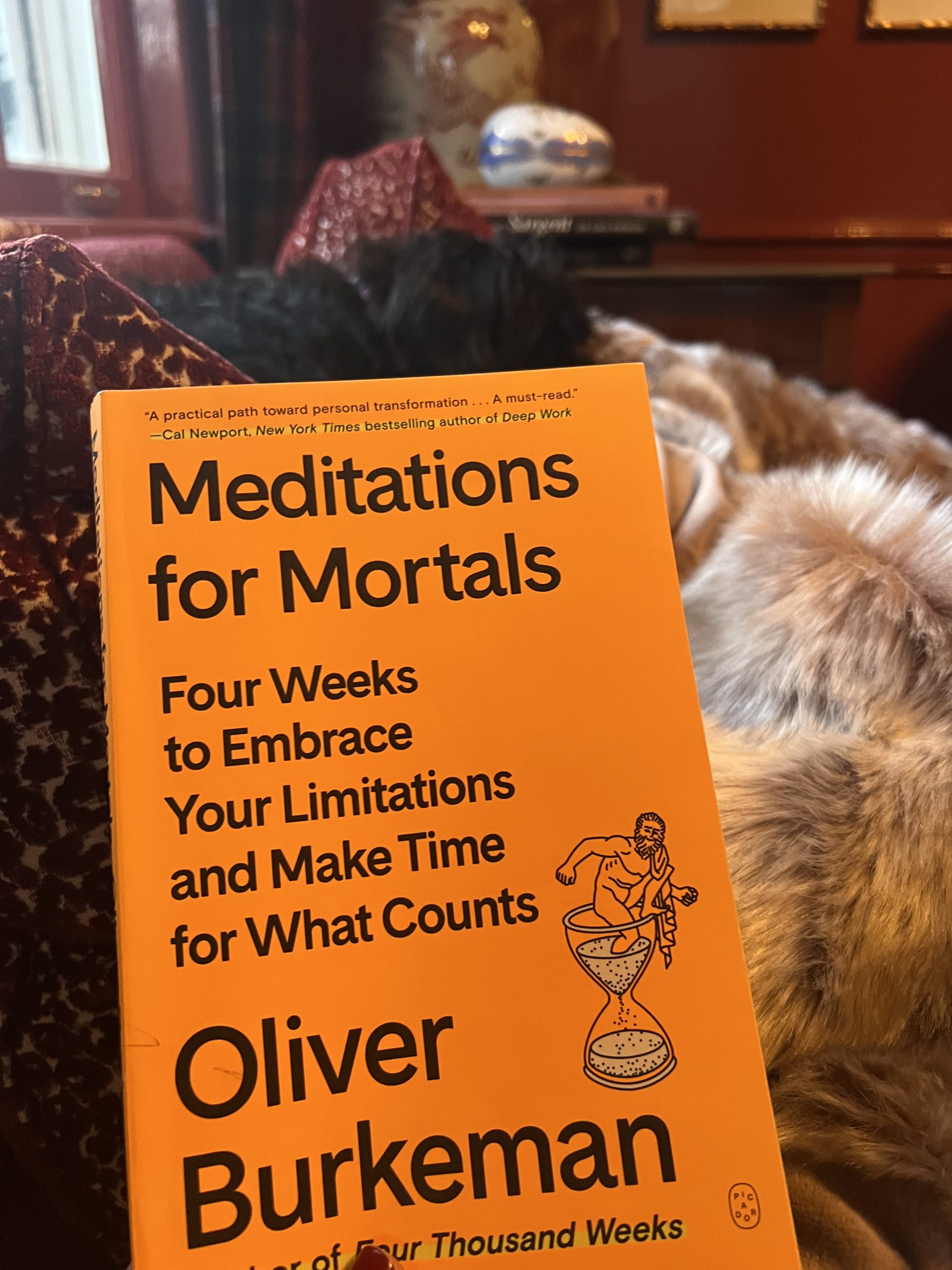
“Not everything that is more difficult is more meritorious.”
-Attributed to St. Thomas Aquinas
Years ago, while researching a book on the pitfalls of positive thinking, I attended a motivational seminar in a basketball stadium in Texas, entitled, appropriately enough, Get Motivated! Needless to say, it was utterly excruciating…
Consider the basic model of human nature implicit in an event like Get Motivated!, and in the idea that worthwhile actions are things you have to ‘motivate yourself’ in order to do. It’s one that assumes you’ll need to gin yourself up, to fill yourself with the necessary supply of energy and self-discipline, if you’re to avoid sliding back to your default setting of lassitude and time-wasting… Meaningful accomplishment, on this account, takes effort. And filling yourself with motivation is one important way to render yourself willing and able to put that effort in.
…Going through your days in this spirit causes multiple problems, the most obvious being that it makes you much less likely to do satisfying things you’d otherwise have done, and that would have been easy, because you’ve persuaded yourself they won’t be. (Arranging a social gathering, setting up a landing page for your business, booking a trip: in principle, any of these might prove to be the work of moments….) Moreover, on those occasions when you do take action, you do so with more exertion and nervous energy than was really required, because it feels like ‘putting in the effort’ is inherently virtuous in itself. That’s a message we begin receiving early in life: ‘My mom used to get really upset at what she perceived as my half-assing,’ reads one splendid anonymous comment on a Washington Post article by the advice columnist Carolyn Hax. ‘I’m 48 now, have a PhD and a thriving and influential career, and I still think there is very little that’s worthy of applying my whole entire ass. I’m not interested in burning myself [out] by whole-assing stuff that will be fine if I half-or quarter-ass it. Being able to achieve maximum economy of ass is an important adult skill.’
The final hazard in the idea that if something matters it must take effort is that it leads, by a seemingly reasonable but entirely bogus reverse logic, to the assumption that whatever takes effort must matter. Collapsing onto the sofa at the end of a long day spent deep-cleaning your home, or organizing all your digital files into an orderly hierarchy of folders, it’s easy to conclude that you must have used your time well: consider how exhausted you feel! But perhaps your home could have waited another month for a deep clean. And maybe you should never have bothered organizing your files at all, because the search function on your computer is amply good enough to track things down when you need to find them.
And so instead of asking how to summon the energy or motivation or self-discipline to do something that matters to you, it’s often more helpful to ask: What if this might be a lot easier than I’d been assuming?
Ironically, this isn’t generally an easy question to bring yourself to ask. It feels like cheating; or else it seems obvious to you that the output you’d produce, were you to approach life in this manner, would lack value… Certainly, many tasks and situations are legitimately difficult in themselves, even distressing. The point isn’t to deny that reality, but to avoid worsening it – and specifically not to turn the fact that life can be difficult into a judgment of inadequacy on your part. The entrepreneur and podcaster Tim Ferris phrases the question slightly differently: ‘What would this look like if this were easy?’ That puts the focus on specifics, on actions you could undertake – and of course the idea isn’t to imagine some parallel dimension in which a task might be easy, but to permit yourself to consider the possibility that it might in fact be easy in this one. The New Age author Julia Rogers Hamrick once wrote a book, Choosing Easy World, in which she argues it’s as simple as repeating a mantra: ‘I choose to live in Easy World, where everything is easy.’ When some daunting challenge barrels into view, just decide that you’re going to experience it as easy instead. I realize that sounds like the worst kind of denial of human limitation, as if you could get your way merely by commanding the universe to fall in line with your desires. In fact, though, it can be surprisingly effective – because it functions not as a mystical command to the universe but as a reminder to yourself not to fall into the old habit of adding complications or feelings of unpleasant exertion where neither need exist.
And we do that all the time. When I fail to take action on things I care about, the reason is sometimes that I lacked the time, or couldn’t summon the willpower. But it’s at least as likely to be because of spooked myself with visions of the perfect result I thought I needed to achieve, or assumptions about the difficulties involved, thereby blocking action that would otherwise have flowed naturally. For example, I must apparently keep relearning the lesson that when I’m preparing to give a public talk, the best approach is to go for a walk with a notebook, list the points that seem most compelling to me, put them in a sensible order, then practice a few times, enough to get a feel for the talk but not enough to render it stilted or rote. Anything more involved than that is asking for trouble: the end result will be worse. And I vividly recall the moment I realized I’d been overcomplicating my son’s fifth birthday party, which had come to feel like a significantly stressful undertaking. What the stress really signaled, I saw, was that I cared about the project, which is entirely different from saying that it needed to be complex or effortful. I like this example because it’s actually quite challenging to think of anything less difficult than making a success of a five-year-old’s birthday party. It’s not a tough crowd. If you can get hold of pizza and ice cream, and order some balloons with LEDs in them online, the truly difficult thing would be to screw it up.
***
Happy New Year, friends! May you find the road easy, and your burdens light. Xoxo


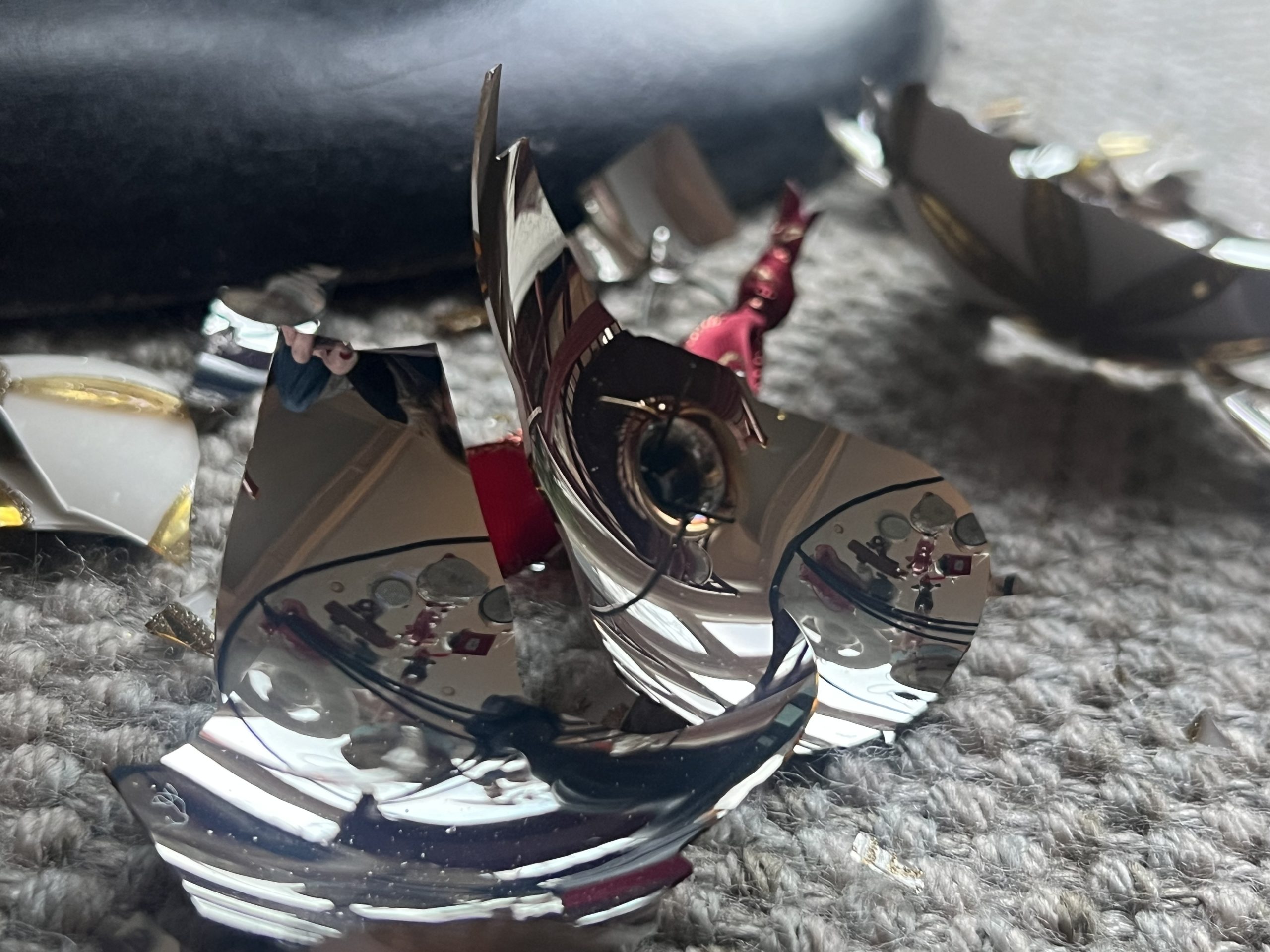

Happy New Year! Only one comment–the picture of the broken glass is brilliant. That is definitely a haiku in the making! (Was it a goblet of some kind.) I always appreciate you nature photos, but the broken one is, well, brilliant. Peace, LaMon
Thank you LaMon! It was a Christmas ornament. Happy New Year! Xoxo
My long awaited closet cleaning begins! It will be easy!
Happy New Year, Jennifer!
Good luck, Marci… I have a few of those ahead of me as well! Happy New Year! Xoxo
My God! Your glorious intellect! Such a fun post. Yes!!!! Let’s not make things harder than they need to be- a worthy resolution, indeed, for the New Year.
Thank you, dear C! Of course it’s Oliver Burkeman who has the shining intellect here. But I love delivering his message to beloved friends! Xoxo
Such a good reminder for the beginning of a new year—and really, for the beginning of every new day. Effort-worship, perfectionism, and toxic productivity are everywhere. I’m an unabashed virtuoso of “half-assing,” and behold: the earth keeps turning.
Often, the simplest mantras are best: comparison is the thief of joy; be a human being, not a human doing; and perfection is the enemy of good. Happy New Year, Jennifer, wishing you much love and peace.
(ps…glad you got the comment link fixed! as you know I tried to comment a week ago!)
Well maybe I should adjust my goals for 2026 to include being a “virtuoso of half-assing” – !! You are as always overflowing with wisdom, Mary Josephine! Xoxo