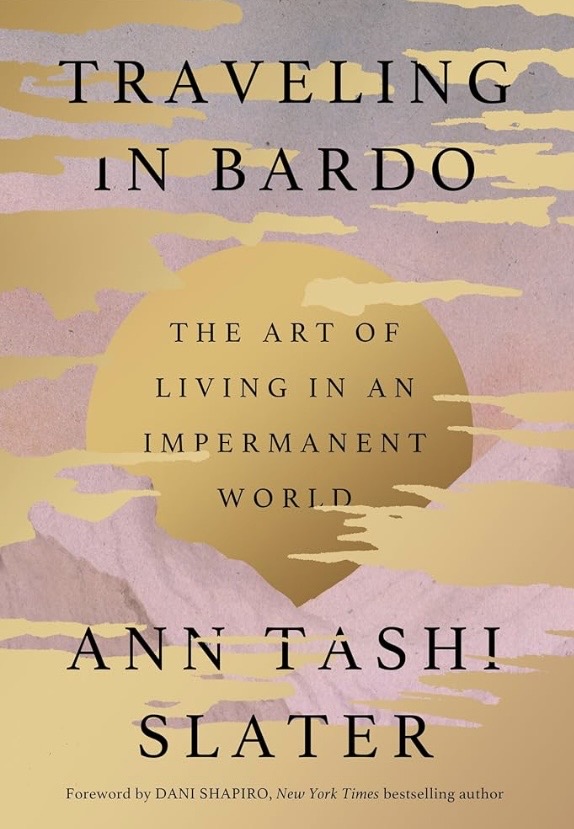
Ann Tashi Slater has written an unusual and effective hybrid of memoir and self-help called Traveling in Bardo: The Art of Living in an Impermanent World. Slater’s mother moved to the United States in 1951, the first Tibetan to attend medical school in America. Slater grew up in New Jersey and California in the 60’s and 70’s wishing she were blond and blue. Later, she became interested in her family’s history in Tibet and India. Her great-grandfather introduced an American scholar and “spiritual adventurer” to a well-known Indian translator. That collaboration led to the first English-language version of The Tibetan Book of the Dead – published in 1927, twelve centuries after it was written. It has never gone out of print.


Slater’s book explores what The Tibetan Book of the Dead has to say about dying – and living. The Book of the Dead outlines specific rituals to help the dead leave their bodies and move through the bardo to awakening and enlightenment. These customs are fascinating in their strangeness. Slater’s additional gift to the reader is to look at the text as a whole and glean its lessons about living. The overarching idea behind the text, and between its lines, Slater believes, is the truth that everything is temporary and always changing. We must hold on more gently to all we cherish, in order to enjoy it more fully and release it more freely when the time comes.
Slater interweaves The Book of the Dead’s precepts with stories of her grandparents’ lives, her parents’ lives, and her own relationships with her husband and children. Slater has lived in Japan for most of her adult life, and she also describes the way Japanese culture has influenced her thinking and her peace of mind. Her work serves as a gentle introduction to the key concepts of Buddhism and illustrates how useful those concepts can be for anyone.
Here’s the passage I want to share with you today:
When my grandfather, Pala, died in 1980, my grandmother made extraordinary efforts to ensure that the traditional rites were carried out for him so he could move forward in bardo. They were on winter holiday in Calcutta where, in their younger days, they had frequented the Flurys tearoom on fashionable Park Street and dined with princes and princesses, rajas and ranis, generals and ambassadors at legendary Firpo’s, which had a live orchestra and a sprung dance floor. (“People used to say there’s never been a dancer like your grandfather,” my grandmother loved to remember. “I was always very proud to be on his arm.”)
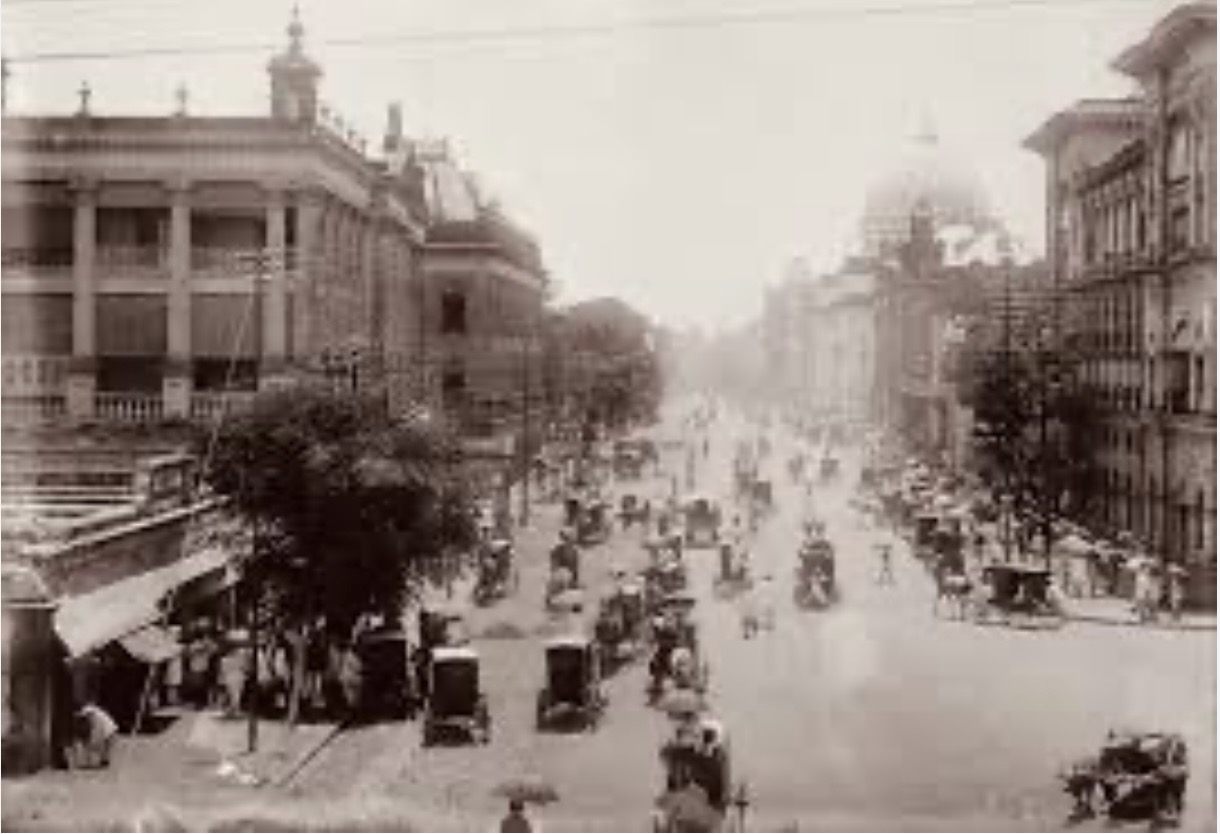
Late one night at their hotel, the December moon low over the sleeping city, my grandmother heard Pala shuffling through papers. “I’m looking for medicine, darling,” he said. “I feel terrible pain in the shoulder blade.”
My grandfather had suffered a heart attack, but instead of taking him to the hospital, my grandmother rushed him up to Darjeeling because she’d seen his death in a dream. “I thought, whatever will happen, let it happen in our own house,” she told me. “Our home in the world where we belong, where we were born and say our prayers, where we’ve walked round the town greeting our friends.”
In Calcutta, they knew people but had no relations. “I knew I must get your grandfather home by hook or by crook,” my grandmother said. “Down there, they’d have cremated his body in the electric machine, without prayers, nothing. We believe the soul will be hovering about the place without the prayers and the burning of the butter lamps.”
Driving up from the plains “slow by slow” in mist “thick as pea soup,” my grandmother brought Pala home so he could let go of the life he’d had and she could begin her journey onward without him after fifty years of marriage. (“For me there was never anyone else. And same for Pala. We never went alone anywhere, we were always together.”) It didn’t mean she wouldn’t grieve, perhaps for a long time, but she wouldn’t deepen her sorrow by clinging to what was now lost to her.
… In “To Philosophize is to Learn How to Die,” an essay I return to often in the copy of the Essais that I inherited from my father, Montaigne writes, “To begin depriving death of its greatest advantage over us, let us adopt a way clean contrary to that common one; let us deprive death of its strangeness; let us frequent it, let us get used to it; let us having nothing more often in mind than death.”
….Montaigne suggests, “Whenever a horse stumbles, a tile falls or a pin pricks however slightly, let us at once chew over this thought: ‘Supposing that was death itself?’” He underscores the relationship between awareness of impermanence and liberation, observing, “To practice death is to practice freedom.”
…By practicing impermanence, we can begin to free ourselves from dread of change and feel greater happiness. Gradually conditioning our brains to be more comfortable with the transitory nature of life changes the way that we engage with it. Even as we experience emotions such as fear or sadness, we can ease our hearts by coming from a place of acceptance rather than attachment or denial, just like my grandmother did when my grandfather was dying. We can recognize that, as the Buddha taught, it’s the belief that we (and everything around us) are solid and unchanging that most makes us suffer, rather than the ephemerality of life.”
***
Sunday afternoon here in Bhutan and I did love reading this (as I do all Bacon posts) and I love that you’ve gone where hardly any of us like to go, at least initially. Here people say we need to think about death at least five time a day. It’s a paradox but doing this brings a sort of lightness. Being on familiar terms with death and impermanence, not clinging, is the ultimate freedom.
Your words go a long way with me, Linda – always. Thank you for being in touch this morning – xoxo
Fascinating book. Great review.
Good morning, dear Jack! I’m so glad you enjoyed it! Xoxo
Food for thought! Carolyn Campbell
Yes!! Xoxo
Grounding post and great review, Jennifer. Adding this to my reading list. Thank you!
I will be so interested to hear what you think, Amy! So look forward to seeing you at book club soon. Xoxo